

Powered by
MOMENTUM
MEDIA

At first glance, Die Hard seems little more than a seasonal spectacle and cinematic bravado. Yet beneath the glass and gunfire lies a quiet study in how violence becomes virtue and loyalty masquerades as justice, writes Rebecca Ward, MBA.
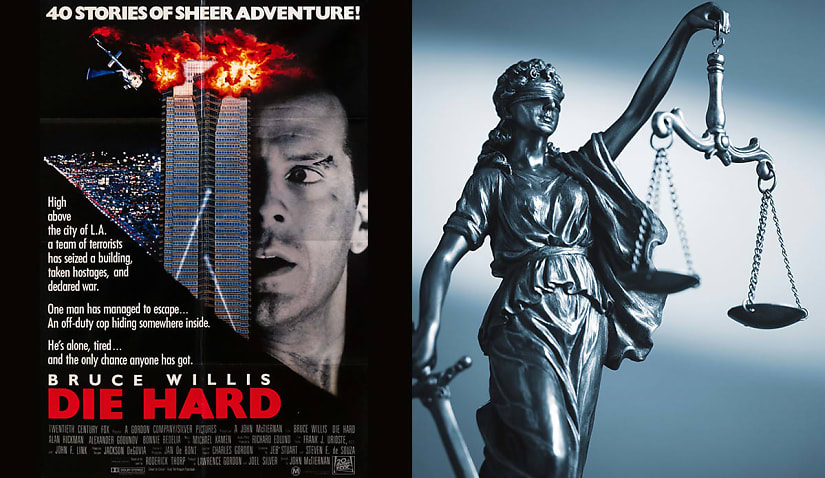

There are films that entertain, films that endure, and then there are those that, almost by accident, reveal something uncomfortably precise about how we assign moral legitimacy. Die Hard occupies that latter category. Ostensibly a familiar action narrative, it also operates as a study in how aggression, power and authority are shielded by narrative permission; not weighed by conduct alone, but softened by allegiance long before ethical scrutiny begins.
For Australian lawyers, conditioned to interrogate structure, motive and consequence, this is not merely cinematic indulgence. It is a case study in how justification is smuggled into moral reasoning, how sympathy precedes evaluation, and how the boundary between heroism and harm is quietly redrawn once the audience has already chosen its side.
The relocation of virtue
John McClane enters the film not as a paragon of restraint or clarity, but as a frustrated, irritable, and emotionally awkward man attempting reconciliation. He has flown across the country (for free) to see his estranged wife and children at Christmas. The gesture is framed as redemptive. He has shown up. That, it seems, is sufficient.
In legal terms, moral credit is allocated before evidence is tested. The narrative sanctifies this minimal relational effort as proof of character, allowing all subsequent behaviour to be interpreted through a buffer of goodwill. McClane’s aggression is no longer evaluated as violence in the ordinary sense. It is rendered necessary. Even admirable. Injury confirms sincerity. Sarcasm becomes authority. Humiliation becomes a strategy.
Once alignment is secured, scrutiny recedes. The audience no longer examines conduct; it protects it. This pre-approval is not incidental. It constructs a moral architecture in which force is not interrogated but excused, not weighed but narratively endorsed.
Power, positioning and permitted behaviour
Hans Gruber, by contrast, is afforded no such generosity. He is controlled, articulate, and methodical. His calm competence is not admired but feared. He is denied complexity and interiority, positioned not as a man with motive, but as an obstacle to be neutralised.
Behaviourally, McClane and Gruber both exert power, manipulate circumstances and cause death. Structurally, only one is permitted virtue. The distinction is not ethical but aesthetic. The same conduct shifts from reprehensible to heroic depending not on outcome but on narrative proximity.
For those accustomed to forensic reasoning, this asymmetry should feel disturbingly familiar. Culpability appears to morph not because behaviour changes, but because narrative allegiance has already been secured. Judgement is no longer analytical; it becomes relational. Harm becomes palatable when delivered by the right hands.
The boardroom, the newsroom, and the battlefield
Die Hard sharpens this distortion through its secondary figures. Ellis, the performatively confident executive, is framed as obnoxious and deserving of his fate. Thornburg, the opportunistic journalist, is depicted as morally contemptible. Neither commits violence. Neither pulls a trigger. Yet both attract greater audience disdain than the man who has already crossed multiple ethical thresholds.
Annoyance appears to offend more than brutality. Social transgression is more than lethal force. The unlikeable becomes more culpable than the killer.
For the legal profession, this invites an uncomfortable inquiry: are we responding to action, or to presentation? Do we condemn based on conduct, or on narrative irritation? When villainy is identified, is it forensic or aesthetic?
Narrative as moral training
Die Hard does not merely entertain; it conditions. It teaches viewers which violence is justifiable, which aggression may be celebrated, and which cruelty can be reframed as courage when packaged with sufficient charm and vulnerability. The brutality is not denied. It is reinterpreted. And with reinterpretation comes permission.
This should unsettle those who operate within legal and institutional power. Courts are not immune to narrative. They respond to tone, coherence, affect, and framing. The aspiration to sterile objectivity is laudable, but incomplete. Even the most disciplined reasoning sits within a narrative scaffold that shapes perception before principle intervenes.
Heroism here is not anchored in ethical restraint, but in positioning. Proportionality dissolves under allegiance. Accountability bends beneath charisma. And once sympathy has attached, scrutiny becomes an inconvenience rather than an imperative.
The legal discomfort that lingers
Die Hard destabilises not because it depicts violence, but because it persuades us to accept it without resistance. It does not invite deep ethical interrogation; it manufactures certainty. The viewer leaves not questioning McClane’s conduct, but reassured by it. That effortless moral closure is perhaps the film’s most sophisticated manoeuvre.
For lawyers, whose very task is to separate story from structure and justification from legitimacy, this should provoke more than seasonal amusement. It should provoke a pause.
It exposes how swiftly moral licence is granted, how easily proportionality erodes once affinity has been secured, and how narrative sympathy can eclipse forensic evaluation before principle has even entered the room. Violence becomes virtue. Authority becomes righteousness. Loyalty becomes moral insulation.
And somewhere in this choreography, critical reasoning quietly withdraws.
Which leaves a more unsettling question for the contemporary legal profession, not about cinema, but about judgement itself.
If ethical frameworks can be so readily softened by narrative positioning, if harm can be redeemed by charm, if brutality can be reframed as virtue, then what, precisely, does that suggest about the lenses through which we determine legitimacy, power, and moral permission?
And only then, perhaps, are we entitled to ask the far lighter question we pretend matters more: whether Die Hard is really a Christmas movie or not?
Rebecca Ward is an MBA-qualified management consultant with a focus on mental health. She is the managing director of Barristers’ Health, which supports the legal profession through management consulting and psychotherapy. Barristers’ Health was founded in memory of her brother, Steven Ward, LLB.
