Defending a Hague Convention case is not about who is the better parent — it is about whether Australia is entitled to decide at all
“When International Law Enters the Family Home: The Retaining Parent’s Defence”
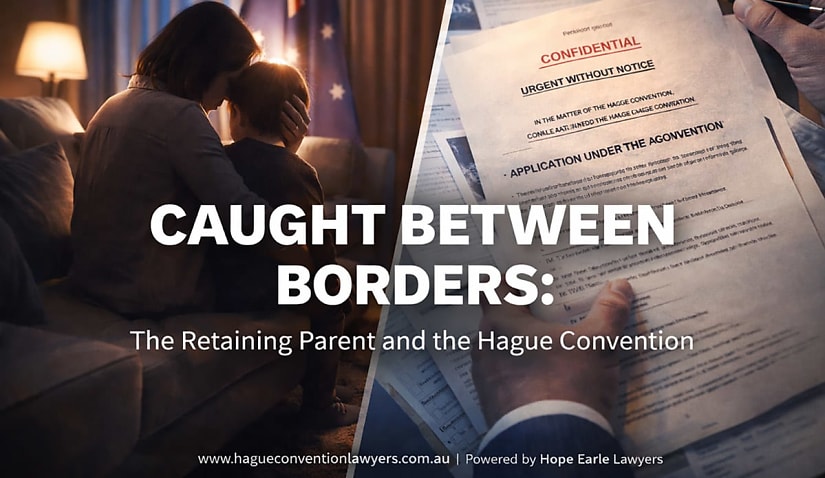

For a parent in Australia who is served with a Hague Convention application, the experience is often deeply disorienting. The documents arrive formally, couched in the language of the return of the child and not about what is in the child’s best interests. This can be difficult because it seemingly disregards best interest principles and simply seeks that the child be returned from Australia.
For many parents, this is the moment they realise that their dispute is no longer simply a family law matter. The Australian court is not being asked to decide where the child should live. It is being asked whether Australia is entitled to decide at all.
That shift is confronting to many clients. It is also where many retaining parents feel most exposed.
Culture, context and the question of risk
In defending Hague proceedings, cultural context is often central to the assessment of risk. Allegations of harm may arise not only from individual conduct, but from systemic features of a foreign legal or social order: the treatment of women, the availability and enforceability of protective orders, trust for the police, the availability of wrap around supports, the practical operation of custody rights, or the lived realities of family violence in another jurisdiction.
These matters are difficult to articulate, particularly for parents who may have felt so unheard that they have had to, on many occasions flee. These nuances must be translated into legally admissible evidence capable of meeting the Convention’s stringent thresholds. Generalised fear is rarely not enough. Nor is moral objection to another system. What matters is whether the evidence demonstrates a grave risk of physical or psychological harm, or an intolerable situation, if the child were returned.
This requires more than ordinary legal skill. It requires an appreciation of how different family systems operate, and how those differences will be understood by an Australian court applying an international treaty. It also requires sensitivity to the fact that the parent raising these concerns is often doing so under immense emotional strain.
Urgency and the burden of proof
Hague proceedings move quickly, by design. The Convention’s effectiveness depends upon speed. Delay risks entrenching a child in a new environment and undermining the very purpose of the regime. If a child is entrenched, and later a change is ordered, this upheaval could be further damaging for a child. Directions are therefore given early, evidence timetables are tight, and defences must be identified and articulated at the outset.
The retaining parent bears the onus of establishing any exception to return. In practice, this most commonly involves a claim that return would expose the child to a grave risk of physical or psychological harm or place the child in an intolerable situation.
Allegations alone are insufficient. Courts require cogent, admissible evidence. Police records, medical material, child protection documents, immigration records and expert evidence often become decisive. What matters is not only what occurred, but whether it can be proven in a form the court can accept.
For practitioners, it is a reminder that Hague work is unlike ordinary parenting litigation.
ICARS and access to representation
Recognising the complexity and high stakes of Hague litigation, Australia operates the International Child Abduction and Return Scheme (ICARS). ICARS provides funding for eligible respondents to obtain legal representation, reflecting an acknowledgment that no parent should be left to navigate these proceedings alone.
In Australia, www.hagueconventionlawyers.com.au (powered by Hope Earle Lawyers), brings together a dedicated team within a broader family law practice to act in Hague matters nationally. Importantly, the team acts for ICARS-funded parents at ICARS rates, ensuring that highly experienced legal advice remains accessible and is particularly important so that the retaining parent does not have to worry about the stress of legal fees on top of other stresses.
“Hague Convention cases are among the most demanding matters in family law, both legally and emotionally. Ensuring that experienced representation is available within the ICARS framework is not simply a service offering — it reflects a broader commitment to access to justice; high quality representation and recognises what is at stake for retaining parents.” says David de Alwis, Managing Principal of Hope Earle Lawyers