

Powered by
MOMENTUM
MEDIA

In a message to the “powerful people” who attended the 2025 Australian Legal Convention, Chief Justice Debra Mortimer urged them to reflect on what they can and should be doing to improve the justice system for Aboriginal and Torres Strait Islander people.
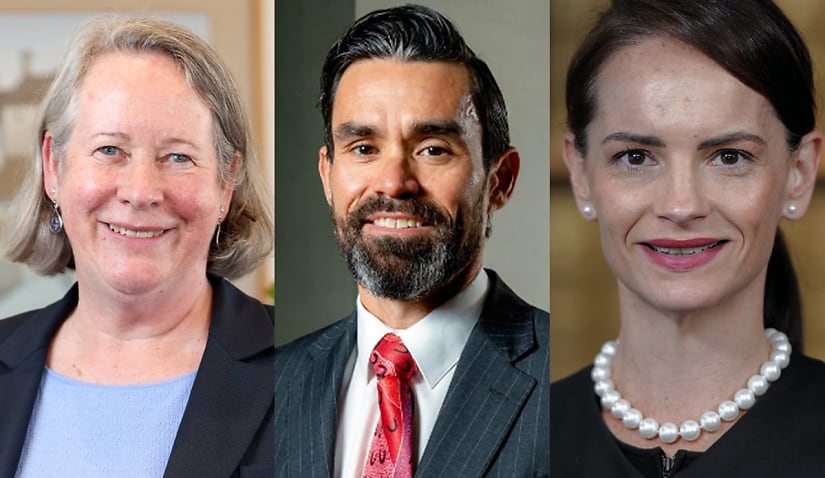

Chief Justice Debra Mortimer of the Federal Court of Australia told an audience of chief justices, judges, and leading legal practitioners that it was time for real action to be taken to address the injustices suffered by First Nations people caught up in the justice system.
“There are a lot of powerful people in this room, and you all know a lot of powerful people,” the Chief Justice said on day two of the 2025 Australian Legal Convention, held at the High Court of Australia.
“We are beyond talking … I implore you to think about what each of you can do to change what you are hearing about.”
The call-to-action followed a plenary address from the Supreme Court of Queensland’s Justice Lincoln Crowley, who became the first Indigenous judge to be appointed to a superior court in June 2022.
Delivered to a captivated audience, Justice Crowley’s address set out alarming statistics: Aboriginal and Torres Strait Islander people make up 36 per cent of the prison population, 22 per cent of people brought to court, and 34 per cent denied bail at first instance.
This is despite Aboriginal and Torres Strait Islander people making up just 3.1 per cent of Australia’s total population.
“Proportionately, we are the most incarcerated people on the planet. We are not innately criminal people,” Justice Crowley said.
Justice Crowley added that the system of justice Australia inherited from Britain does not “in any real, meaningful way” reflect traditional customs. Rather than change it, politicians have done the opposite.
“Governments seek to outdo each other and toughen crime, [and] law and order agendas without considering the effects upon the most disadvantaged in the community, because those laws inevitably impact disproportionately upon the most disadvantaged, most vulnerable, which of course is First Nations people,” he said.
Justice Louise Taylor, the first Aboriginal judge to be appointed to the ACT Supreme Court, told the same room that Indigenous people were “here in spite of the law”, and it was a testament to the strength of their ancestors, their culture, and their connection to each other.
“The attempt to exterminate us was facilitated by laws which entrenched our disposition. By the theft of our lands, by erasing or demonising our culture, and by undermining our individual and collective dignity. Those laws ensured the spoils of colonisation were locked in, and they were not for us,” Justice Taylor said.
Speaking to Lawyers Weekly, Chief Justice Mortimer said her call to colleagues was to consider the impact of their actions and decision making on Aboriginal and Torres Strait Islander people.
“It’s not necessarily to always favour First Nations people, that’s not what I’m getting at, but [to consider if] the interests and needs of First Nations people are front of mind for us, and are we all giving the emphasis for thinking about those factors when making decisions?
“That’s what I think we need to do a little more of, and not just always leave it to First Nations people themselves to do that,” Chief Justice Mortimer said.
In her plenary address, Justice Taylor said the fact of “our special, unique connection to this land” sits at the heart of what Aboriginal people refer to as “unfinished business” or the failure to properly reckon “with the original grievances of dispossession”.
“That unfinished business casts a long shadow, and it is in that shadow that our people view the law, interact with the law, and feel the effects of the law,” Justice Taylor said.
Reflecting on the High Court, Justice Taylor said the building witnessed many failings and achievements for Indigenous people. This included Mabo v Queensland (No 2), which saw the full court finally recognise the existence of native title in Australia.
In the judgment, Sir Francis Gerard Brennan wrote that it took Australia more than 150 years to accept a version of “our truth”, and one that is compatible with his description of a “skeleton of principle which gives the body of law its shape and internal consistency”.
“I cannot help but observe that it took another 30 years for Lincoln to be the first Aboriginal person appointed to a superior court in this country.
“If the skeleton of principle gives our body of law its shape, then those who administer it must surely put the meat on the bones of how the law lands in the lives of all Australians,” Justice Taylor said.
More from the 2025 Australian Legal Convention:

