

Powered by
MOMENTUM
MEDIA

Following the Bondi massacre, NSW’s top judge warned that the horrific attack had revealed a disturbing surge in anti-Semitism, urging Australia’s legal profession and broader community to strengthen social cohesion and confront hatred before it fractures society.
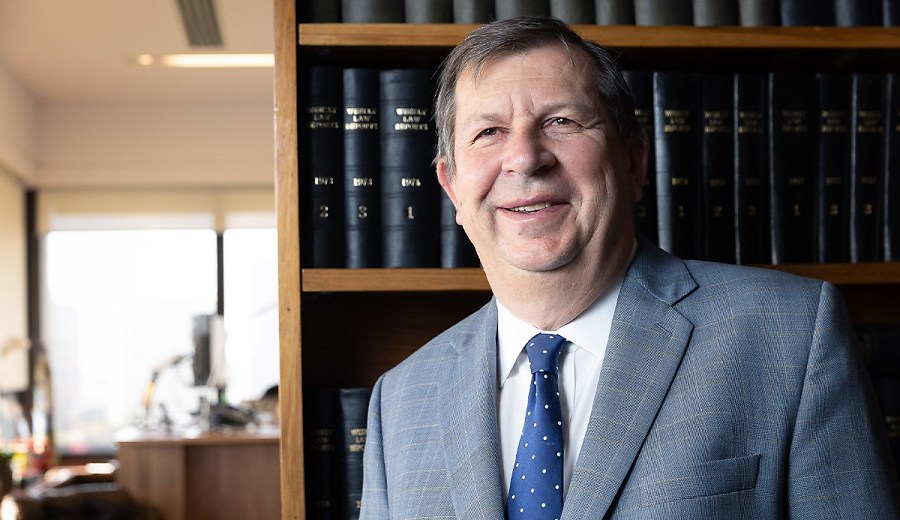

Addressing NSW practitioners at the Opening of Law Term Dinner (Thursday, 5 February), Chief Justice Andrew Bell (pictured) delivered a powerful condemnation of last year’s shattering Bondi massacre, warning that the attack had exposed a deeply troubling surge in anti-Semitism now threatening social cohesion across Australia.
Speaking publicly for the first time since the horrific Bondi attacks on 14 December 2025, Bell CJ described Sydney’s “relatively stable and peaceful world” as having been brutally torn apart, with shockwaves reverberating far beyond the city and across the nation.
Bell CJ extended his heartfelt sympathy to the families of those killed, the surviving victims, and members of the Jewish community, acknowledging that they have been, and continue to be, profoundly affected by the “act of unvarnished hatred and evil” that was carried out.
“To the families of the victims, the surviving victims, including the countless victims who will undoubtedly have been traumatised through their presence and proximity, and to the Jewish community, in particular, I extend my deepest sympathy,” Bell CJ said.
In response to the massacre, a royal commission has been established to examine not only the immediate circumstances of the Bondi attack but also the broader environment in which anti-Semitism has been allowed to flourish and be exploited.
While Bell CJ made clear that anti-Semitism is neither new nor unique to Australia, he emphasised that its modern forms must be understood in the context of contemporary technology and global influences.
“Anti-Semitism is, of course, no new phenomenon unique to Australia,” Bell CJ said.
“Nevertheless, its most recent manifestations have to be understood in the context of our contemporary world, including the world of the dark web, readily accessible communications technology and networks that lend themselves to the propagation of hatred, the facilitation of evil acts and the dissemination of wicked mis- and disinformation.”
While Bell CJ acknowledged reports that the recent tragedy may have involved “lone wolves”, he warned of even more alarming findings from last year, when ASIO concluded that a spate of anti-Semitic attacks in Australia had been deliberately “directed by the Iranian state”.
That assessment, publicly confirmed in a joint statement by the Prime Minister and the Ministers for Foreign Affairs and Home Affairs – and cited by Bell CJ – described the conduct as an “extraordinary and dangerous acts of aggression orchestrated by a foreign nation on Australian soil”.
For Bell CJ, such actions were intended to “undermine social cohesion” and deliberately “sow discord within our community”.
The royal commission, to be led by former High Court Justice the Honourable Virginia Bell AC SC, was acknowledged by Bell CJ as a “large and dauntingly complex task”, but he expressed strong confidence in her “deep experience, empathy [and] commonsense” to guide the inquiry.
Situating Australia’s current moment within a broader regional and international context, Bell CJ drew parallels with the 2019 Christchurch mosque shootings in New Zealand, where 51 people were killed by an Australian-born gunman.
Quoting from the opening section of New Zealand’s royal commission following the Christchurch attacks, Bell CJ highlighted how themes of “social cohesion, inclusion and diversity” resonate closely with – and should similarly guide – Australia’s own inquiry.
“The fabric of our society in New South Wales and Australia more generally is woven with many different and diverse cultural, religious and ethnic strands,” Bell CJ said.
“Such diversity is a fact and strength of our community and indeed of our legal profession here in New South Wales, which, as any of you who have attended an admission ceremony in the last decade would realise, is growing at a rate of knots in terms not only of gender but also of ethnic diversity.”
Bell CJ pointed to the legal profession as a tangible example of this diversity in action, noting its potential to model the social cohesion Australia needs.
“This is a very good thing, and the legal profession can and should strive to foster and represent the example of the social cohesion we need more generally as an antidote to the hatred and hostility, which was at the centre of the two shocking events on either side of the Tasman in the last five years, each of which was directed at different religious and cultural communities,” Bell CJ said.
However, Bell CJ cautioned that social cohesion could not be sustained without meaningful human interaction, warning that recent social trends risked deepening division rather than fostering understanding.
“I would venture to suggest, hardly radically, that social cohesion requires meaningful social, human interaction,” Bell CJ said.
“The retreat by many into their own cocoons, driven by the pandemic but continuing after its resolution, allied with algorithm-driven social media with its insidious tendency to create prejudice-reinforcing echo chambers, does not enhance social cohesion nor stimulate genuine societal engagement.”
Instead, Bell CJ called for renewed commitment to in-person discussion, respectful engagement and openness to difference.
“That requires meaningful in-person discussion, respectful interaction with each other and a willingness to embrace differences rather than reflexively to repel them,” Bell CJ said.

