

Powered by
MOMENTUM
MEDIA

Despite years of efforts to advance gender equality across the legal profession, many female lawyers say the fight for genuine equality is far from over. Here, Lawyers Weekly explores the areas where women believe their firms continue to fall short compared to their male counterparts.


What is the Legal Firm of Choice Survey?
Now in its 11th edition, the Top 25 Attraction Firms ranking is a defining feature of the Legal Firm of Choice Survey, which identifies the most sought-after private legal practices across Australia.
The latest survey was conducted from 1 April to 31 May and garnered a total of 612 responses from legal professionals currently engaged in private practice throughout the country. It recorded the attitudes, priorities, and perceptions of these practitioners, offering a valuable glimpse into the evolving landscape of the legal profession.
Last month, Lawyers Weekly also published The Top 25 Attraction Firms ranking for 2025-26, revealed which BigLaw firms are climbing in popularity and which are slipping among lawyers this year, and uncovered that more than 20 per cent of lawyers intend to leave their jobs this year.
The methodology
The survey asked participants to evaluate their firm based on a wide range of attributes, including the company culture, flexible work options, support for employee wellbeing, communication effectiveness, and opportunities for career advancement.
The findings revealed notable discrepancies between how male and female lawyers perceive their firms’ accomplishments and support regarding these attributes.
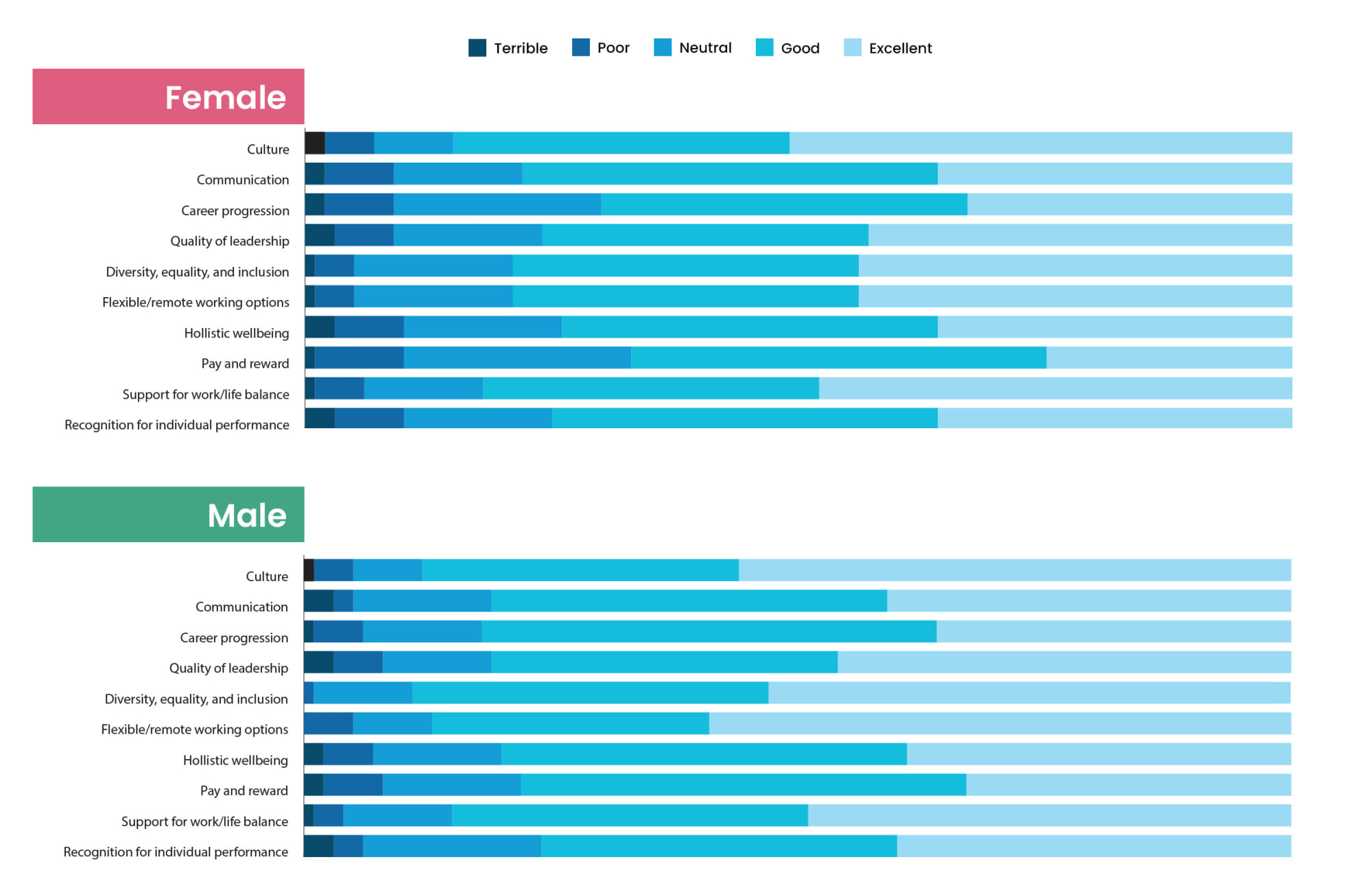
Career progression emerged as the most significant area of disparity, with 29 per cent of female respondents saying their firms were falling short in supporting their ability to advance within the organisation.
Of those respondents, 6.8 per cent rated their firm’s support as poor, while a further 2.5 per cent went further, describing their firm’s efforts in this area as terrible.
The contrast was particularly pronounced when compared with male lawyers, with just 8 per cent of male respondents expressing concerns about their firm’s support for career progression.
Among male respondents, 5.6 per cent rated their firm’s efforts as poor, while 3 per cent described them as terrible.
Remuneration was another key area where perceptions differed between male and female lawyers, with the findings revealing a gender divide in how lawyers view whether they are being fairly rewarded.
While 66.6 per cent of female respondents rated their pay positively, a significant proportion remained unconvinced, with 33.2 per cent not viewing their remuneration as good or excellent.
Among female respondents, 9 per cent said their pay was poor, while a further 1.4 per cent went further, describing their remuneration as terrible.
Male lawyers, however, reported significantly stronger perceptions of their remuneration, with 81.7 per cent rating their pay as either good or excellent.
Only 6.5 per cent considered their remuneration poor, while 1.7 per cent described it as terrible.
Communication was another area where perceptions differed, with female lawyers slightly less likely to feel positively about how effectively their firms engage with them.
While 78 per cent of female respondents reported positive views towards their firms’ communication, this figure rose to 81 per cent among male respondents.
Other areas worth noting include that 85 per cent of female respondents reported positive support for work/life balance, 76 per cent felt they were recognised for their individual performance, and 75 per cent said their firms actively supported their holistic wellbeing.
Unlike last year’s findings, where female lawyers expressed stronger confidence in areas such as career progression and work/life balance support, this year’s report found no workplace attributes where women rated their firms more positively than their male counterparts.
How can the profession address these gaps?
Given the clear differences in how female lawyers perceive their treatment and support within their firms, the legal profession must address these concerns to ensure progress towards gender equality continues rather than risks going backwards.
For Victoria-Jane Otavski, managing partner at BlackBay Lawyers, the answer does not lie in creating separate pathways or offering preferential treatment for female lawyers, but in ensuring firms establish the foundations that allow every lawyer to succeed.
Instead, she argued that genuine progress comes from building workplace cultures where every lawyer is supported through meaningful mentorship, challenging work, honest feedback, and opportunities based on merit.
“What firms should be doing for their female lawyers is what firms should already be doing for every lawyer,” Otavski said.
“It involves providing genuine mentorship, substantive work, honest feedback, meaningful opportunity, and offering true meritocracy. It involves setting high expectations paired with the support to meet them, and recognising every lawyer has a life beyond the office.”
Otavski argued that embedding these “not gendered conditions” into the culture of every firm creates an environment that “produces strong senior practitioners of any kind”, benefiting lawyers regardless of gender.
Rather than focusing solely on demographic-driven initiatives, Otavski believes firms should invest in individual talent and ensure meritocracy is reflected in practice, allowing talented women to progress alongside their peers because of their capability and achievements.
“Firms that invest in the individual rather than the demographic, and that operate as a genuine meritocracy in practice, will find that talented women progress alongside their peers as a natural consequence,” Otavski said.
Meanwhile, Belinda Cohen, chief executive of Gilchrist Connell, said the firms making the greatest progress in advancing women are those willing to rethink traditional workplace structures and create environments that reflect the realities of modern life.
“While women in the legal profession continue to face barriers, the firms making the greatest progress are those that focus on building workplaces that reflect the realities of modern working life,” Cohen said.
Policies once seen primarily as supporting women in the workplace have, she stressed, now evolved into essential expectations that lawyers at every stage of their careers value in the firms they work for.
“Flexibility, part-time career pathways, transparent promotion processes and support for carers are often discussed through the lens of gender, but they are increasingly valued by employees at every life stage and by people with a wide range of commitments outside work,” Cohen said.
She argued that firms capable of supporting lawyers to perform at their highest level while also balancing responsibilities outside work will be better positioned to attract and retain leading talent.
“The real opportunity for firms is to create an environment where talented people can perform at a high level while also meeting their personal responsibilities,” Cohen said.
“Firms that get this right will be better placed to attract, retain and develop outstanding talent, regardless of gender, while building a more engaged and sustainable workforce.”
Bartier Perry chief people officer Nadine Cooper said that while progress has been made, the path to senior leadership remains uneven for many female lawyers, with career progression, access to leadership opportunities, pay equity, and caring responsibilities continuing to influence their career trajectories.
“Many of the barriers that continue to impact female lawyers relate to career progression, access to leadership opportunities, pay equity, and balancing professional and caring responsibilities,” Cooper said.
Cooper stressed that addressing these challenges requires firms to move beyond conversation and take deliberate action, embedding policies and accountability measures that create lasting workplace change.
“Firms can address these challenges by embedding flexible work, equitable parental leave, transparent promotion processes, targeted sponsorship and leadership development, and regular gender pay gap analysis,” Cooper said.
Cooper said Bartier Perry is seeking to turn gender diversity commitments into measurable progress, with initiatives spanning flexible work, pay equity monitoring, and leadership development aimed at strengthening the pipeline of future female leaders.
“At Bartier Perry, these priorities are supported through our board-approved 2024–27 DEI Strategy, quarterly reporting of diversity and cultural health metrics, flexible work for all, 20 weeks’ gender-neutral paid parental leave, active monitoring of pay equity, leadership development for female talent, scholarships for women, and a clear focus on increasing gender diversity at senior levels,” Cooper said.
“While there is always more work to be done, I am encouraged by the strength of the female talent pipeline emerging at Bartier Perry and the positive impact these initiatives are having on creating future leaders within the firm.”

