

Powered by
MOMENTUM
MEDIA

Speaking recently at the Harvey FORUM Sydney 2026, former prime minister of New Zealand Jacinda Ardern reflected on how to think about new technologies, decision making, decisiveness, and choosing the “path of least regret”.
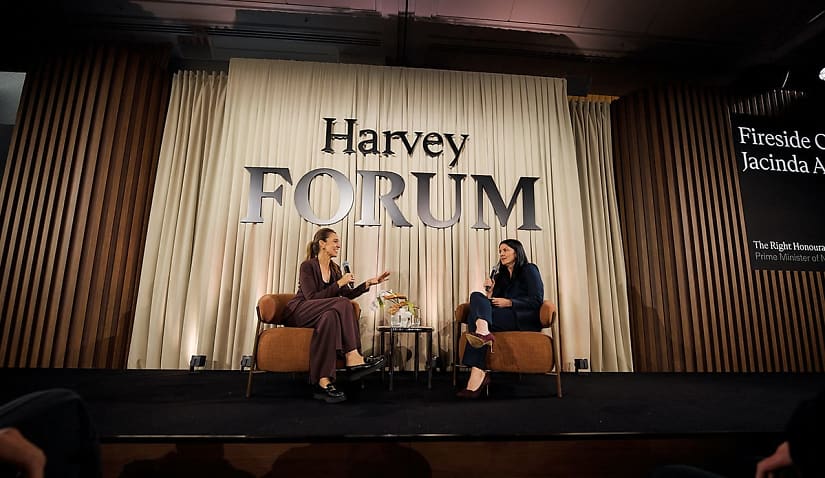

Navigating uncertainty, including the uncertainty around AI, was the subject of a fireside chat between Ardern and Harvey’s chief operating officer, Katie Burke, about New Zealand’s COVID-19 response while she was in office, the need for leaders to try hard things from the outset, share what they do not know, and treat empathy as a strength in decision making.
Noting that lawyers across the country are navigating uncertainty with AI, and that there is “not a perfect playbook” to go by, Burke asked Ardern how leaders can and should balance their advice against the reality that “no one has ever done this before”.
Ardern said there were “two really important lessons from COVID in that regard”, and reflected an earlier crisis faced by NZ. The first disease outbreak that her government had to manage when taking office, she said, was not COVID-19 but Mycoplasma bovis, a bovine disease. In a country “that has more cows than people”, it was threatening the national herd, she explained.
The disease had broken out in the South Island and was moving across the country, Ardern said, just ahead of Gypsy Day, a day on which livestock moves around the farming community. No country had ever eradicated it, she said, and the projected loss was about NZ$1 billion in productivity from the dairy sector over 10 years.
Ardern’s response was to seek out a country with experience of the disease, and so, her government contacted Ireland. The advice, Ardern said, was: “If you’ve got any chance, you should try.” That was compelling, Ardern said, because a failed attempt would leave New Zealand “no worse off than anyone else”.
Ardern was open about the cost. If a herd is affected, “you have to kill every cow”, and so the government made the decision, alongside the farming community, sharing all of the information and data it had. New Zealand, Ardern said, is now on track to be the first country in the world to eradicate the disease.
The same mindset carried into COVID-19, Ardern said, and informs how she thinks about new technology.
There is “a legitimate place” for the idea of the path of least regret, she said, and guardrails around AI “are hard to put around you after the fact”. Regulators in particular, she noted, should try to take that path from the outset, so that in 20 years’ time no one is saying “if you can do something, you should have tried”.
Burke said the first step of picking up the phone showed curiosity without perfect information, and that Ardern had “brought people along”. The former PM responded that the lesson mattered more in an information age where people receive “short snippets of information”, often presented in a binary way, while the decisions leaders face are “imperfect” and “grey”. Leaders tend to believe that admitting a gap in knowledge will erode confidence, Ardern said, before asking: “When was the last time you heard a politician say the words I don’t know?”
During COVID-19, Ardern went on, the public could see that the government did not know everything, so it said so, and then set out what it did have. Every day at 1:00pm, Ardern held a press conference of at least an hour, alongside the nation’s chief science adviser. Lockdown meant New Zealanders tuned in, and “5 million people simultaneously became epidemiologists”, which Ardern said “has its upsides and its downsides”.
People then understood the decisions and were often calling for them before the government reached them, she said. Admitting information gaps built trust, and it also created “a real permission space” to shift strategy repeatedly.
Asked how to reconcile decisiveness with empathy, Ardern described a process that began with over-preparation, which Ardern linked partly to “old habits of imposter syndrome”. She would try, she recounted, to understand a situation fully, then seek the best expertise available, and only at the final stage allow instinct to come in. Instinct, Ardern said, “doesn’t come from nowhere”, and she would be wary of using it “straight off the bat, without the preparation”. If an overnight decision did not sit well, Ardern said, it needed to be revisited.
On tension, Ardern rejected the premise that an empathetic leader will dither. “The opposite for me was true,” Ardern said, because being guided by life and death decisions and a wish to prioritise people’s health and wellbeing made the course of action clear. Doubt about whether one is the right person for the job, Ardern said, becomes “almost self-indulgent” once a leader has the role, because there is “a responsibility … to crack on with it”.
Asked how she stays motivated on difficult days, Ardern pointed to a recent global survey from Edelman, showing “an age of insularity” in which 70 per cent of people do not trust those with different opinions. But, she added, the same data shows people recognising this as a problem, and that employers should do more to bridge the gaps.
Ardern said: “I’m an optimist. I see optimism as an active choice. You can always find optimism and hope in the darkest moments.”
And on the topic of AI, Ardern said that she has indeed used the technology since her days in office, noting “it was important to understand the interface, the upside of its use, the cons … just the reality”.

